Guides
Power Conditioner vs UPS: Music Studio Comparison
Power conditioner vs UPS music studio guide: compare noise filtering, outage protection, sizing, and which setup fits each studio need.
What to take away
- A power conditioner filters noise and clamps surges. It holds no energy, so it cannot carry a session through a blackout.
- A UPS carries the load for minutes, not hours, and only if you size it against your actual watt draw.
- Buy both when you have sensitive converters and a consoleconditioner at the rack, UPS on the devices that lose data when power drops.
- In hurricane-prone states, size the UPS for safe shutdown and file saving, not for finishing the mix.
- Neither device fixes bad wiring, a shared neutral, or a generator that produces dirty sine wave output.
What is being compared
The two boxes are sold as if they do the same job. They do not.
A power conditioner takes wall current and cleans it: it filters high-frequency noise, clamps voltage spikes, and provides a rack-mounted distribution point with metering. A UPS stores energy in a battery and inverts it to AC, so gear runs when utility power stops.
Most studio owners need an answer to one question. What happens in the four seconds between the lights flickering and the power returning? A conditioner passes that event straight through. A UPS covers it. That single difference drives the purchase decision more than any specification sheet.
The criteria that matter
Power conditioner
- Holds energy for outages
- No
- Filters line noise and RFI
- Yes
- Clamps surges
- Yes
- Voltage regulation
- Some models, narrow range
- Battery replacement cost
- None
- Rack space
- 1U to 2U
- Typical US street price
- $150 to $1,500
UPS
- Holds energy for outages
- Yes, typically 5 to 20 minutes at half load
- Filters line noise and RFI
- On better models only
- Clamps surges
- Yes, plus battery isolation
- Voltage regulation
- Double-conversion models hold tight output
- Battery replacement cost
- Roughly $80 to $400 per string, every 3 to 5 years
- Rack space
- 2U to 4U
- Typical US street price
- $300 to $3,000
Prices above are illustrative ranges from US retail listings, not quotes. The Wikipedia entry on power conditioners explains the filtering function in plain terms, and the UPS overview covers battery topologies. For power-quality guidance, consult IEEE Std 1100, Recommended Practice for Powering and Grounding Electronic Equipment (the Emerald Book). Check product safety certifications against UL 1449 for surge protective devices and UL 1778 for UPS equipment.
Option by option
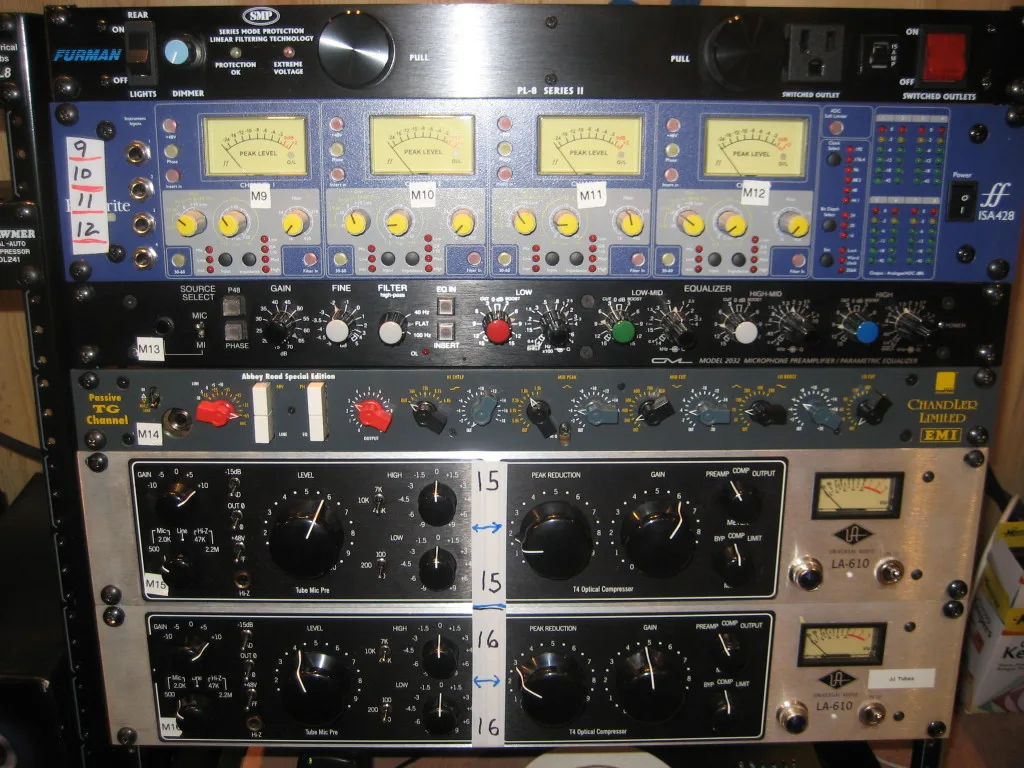
A power conditioner suits a room with clean utility power and one recurring problem: audible hash on the lines. It belongs in the rack feeding your interface, preamps, and monitors.
Owners who record in older buildings with motors on the same circuit often hear the difference immediately. If the complaint is a buzz changing when the refrigerator kicks on, this is your box.
UPS Sizing Arithmetic
- 30%headroom to add
- 600Wexample load
- 900VAunit size at 0.7 PF
A UPS suits anyone who loses work when the power drops. That means a computer running a session, a drive array writing files, and any digital console that takes 90 seconds to boot. Line-interactive units cover short sags and outages. Double-conversion units cost more and run hotter, but they isolate the load completely.
Sizing is arithmetic, not guesswork. Add the wattage on labels of everything you plan to plug in, then add 30 percent headroom. A 600W load needs roughly a 900VA unit at a typical 0.7 power factor.
If you track in Florida or along the Gulf, where outages run long after storms, aim for a controlled shutdown, not a continued session. Pair the UPS with the gear-storage planning in our guide to climate control for a music studio in Florida, because heat and humidity shorten battery life.
Where each one wins
Advantages
- Power conditioner wins on noise floor, cost per outlet, and rack simplicity. It never needs a battery.
- UPS wins on data protection and on any session where a crash costs more than the hardware.
Drawbacks
- Neither wins on a circuit that is already overloaded. Call an electrician first.
A $400 UPS that covers a $3,000 converter and an unsaved take pays for itself the first time the grid blinks.
Example: a two-room build in New Orleans
A tracking room and a mix room share a service panel. The owner buys one 20A conditioner for the tracking rack and one 1500VA line-interactive UPS for the mix computer and interface. Total spend sits near $900, well under one ruined session day.
The same logic applies to booking pressure during storm season, which we cover in how festival season shapes studio bookings in Austin and New Orleans.
Checklist before you order:
- Check that the product’s ratings match the gear you plan to connect. Add the equipment wattage and 30 percent headroom; compare the UPS’s watt and VA ratings with that load.
- Look for safety certification to UL 1449 for surge protective devices and UL 1778 for UPS equipment.
- Choose a line-interactive UPS for short sags and outages, or double-conversion if you need complete isolation. Plan for safe shutdown rather than finishing a session.
- Reserve UPS battery power for the computer, drives, and other devices that need to save work. Use a conditioner for rack gear when line noise is the problem.
- Check the circuit and wiring first. Neither device fixes an overloaded circuit, a loose neutral, or a shared ground.
Before You Order
- List every device and its wattage
- Confirm UPS transfer time under 10ms
- Verify circuit breaker amperage
- Budget battery replacement every 3-5 years
What none of them solve
Both devices sit downstream of your wiring. A loose neutral, a shared ground, or a panel with aluminum branch circuits will still cause problems no rack unit can correct.
Neither extends runtime past its battery capacity. Neither stops a direct lightning strike on the service entrance. Whole-home surge protection at the panel and a licensed electrician remain the foundation.
If you are writing client agreements that address downtime, the clauses in our music studio client contract template are worth reading before you promise a delivery date. Studios that document their power setup also tend to document everything else, which is why keeping a music studio owners to standard is a useful companion read.