Guides
Budgeting SOCAN and Re:Sound licences in a Canadian studio rate card
How a Canadian music studio budgets SOCAN and Re:Sound licences: what sets the fee, combined or separate invoices, and the hourly line for your rate card.
What to take away
- A Canadian music studio that plays recorded music its clients can hear carries two licence costs: one for the composition and one for the recording. Both belong in the rate card.
- The fee follows square footage, not how many sessions you book. That makes it a fixed annual cost, and a fixed cost is divided by the hours you expect to book.
- Entandem, the joint SOCAN and Re:Sound licensing service, publishes a combined background music licence that starts at $96 a year for a small premises. Bought separately, the invoices typically run about $100 to $350 for SOCAN and $100 to $300 for Re:Sound. Treat those as illustrative ranges.
- In the worked example below, the two licences add about $1.15 to each booked hour.
- A consumer streaming account does not cover a commercial studio. Neither licence clears music in your promo videos.
Two licences, one cost line
Playing recorded music where clients can hear it is a public performance, and each track carries two separate rights. That covers the control room, the live room, and the front desk.
The Copyright Act gives the owner of a work the sole right to perform the work in public. SOCAN collects for songwriters and music publishers, so it is the first invoice a studio meets.
The same Act says that once a sound recording is published, the performer and maker are entitled to be paid equitable remuneration for its performance in public. Re:Sound collects for performers and the labels that own the recordings, and it is the second invoice.
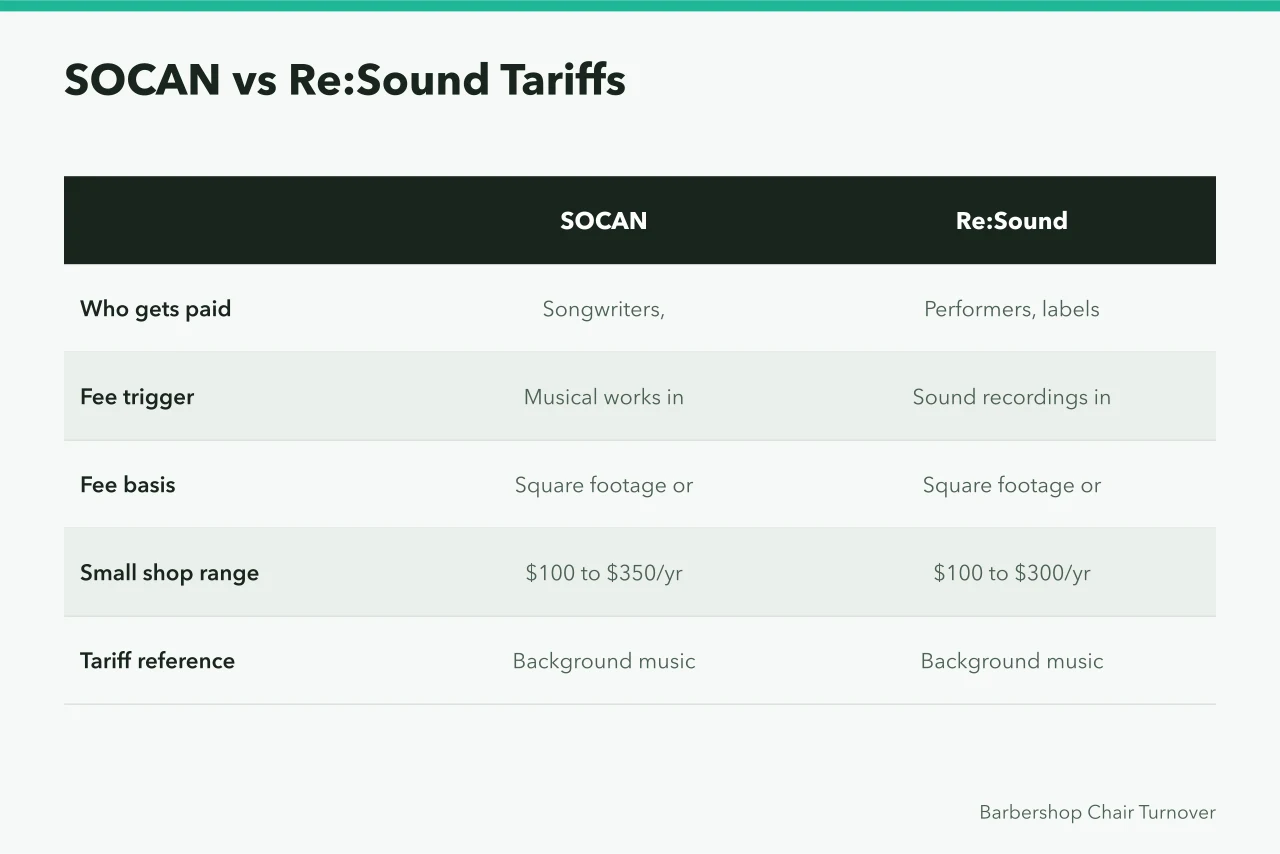
The two fees do not offset one another. One track carries two rights, so paying SOCAN leaves the sound recording uncleared. Before you ask for a quote, describe each use of music in the room, because the quote follows the description.
If a client in a studio room can hear music you put on, you are performing it in public. Both licences can apply.
What sets the fee
The fee follows square footage, not session count, so a quiet month costs the same as a busy one. On premises the size of a working studio, the annual figure turns on square footage. The province and the tariff year move the number.
Check the current tariff before you budget. The Copyright Board publishes approved tariffs, and Entandem posts fee calculators. Rates differ by province and change with the tariff year, so recheck at every renewal. The licences a studio needs sit beside permits and zoning in the wider cost picture.
Combined or separate invoices
| Route | Illustrative annual cost | What it covers |
|---|---|---|
| Combined Entandem licence | Starts at $96 for a small premises | Both the SOCAN and the Re:Sound licence |
| SOCAN invoice, bought direct | About $100 to $350 | Songwriters and music publishers |
| Re:Sound invoice, bought direct | About $100 to $300 | Performers and record labels |
The ranges are illustrative, and the fee basis is the square footage or capacity of the premises. Bought separately, neither invoice cancels the other, and the two societies do not split a single payment. Put both invoices on one renewal date so neither lapses.
Worked example: a two-room studio in Hamilton
The numbers here are illustrative. Take 900 square feet and two rooms. An Entandem quote lands near the published floor of $96 a year. Bought direct, the invoices come to roughly $150 and $140.
That is about $290 a year. Spread across 250 booked hours, it adds about $1.15 an hour. Put it in the rate card and January stops being a surprise.
- Ask Entandem for one combined quote in writing, with the tariff year named.
- If you buy direct, add both invoices into one annual total.
- Divide the total by the hours you expect to book in the year.
- Add the result to the hourly rate as an overhead line, and recalculate when the tariff year changes.
The monthly measures your booking records give you supply the divisor in step three. The software subscription costs of a two-room suite use the same per-hour method, so the two lines sit together in the rate card.
Where licences sit among fixed costs
Licences are one fixed cost among many. What soundproofing a studio costs usually outweighs them across a five-year fit-out, and both belong in the same overhead line.
The startup costs put the one-off build and the recurring annual lines side by side. A licence is small beside the build, but it comes back every year.
What the licences do not cover
Sync rights for video, hold messages, and social clips sit outside both licences. A promo reel scored with a licensed track still needs clearance from the rights holder.
Ignoring a tariff does not make it disappear. The societies audit premises, and the Copyright Board can approve retroactive fees. A studio found short may owe back fees plus interest.
Common questions
Does the fee change with how many sessions we book?
No. The fee follows square footage, so a quiet month costs the same as a busy one. That is why it is divided across booked hours rather than charged per session.
Can staff use a personal Spotify account in the control room?
No. Consumer plans do not grant public performance rights for a business. The studio needs both licences, or one combined Entandem licence.
What happens if we ignore the tariffs?
Back fees plus interest. The societies can also pursue the matter in court.
How often does the number change?
Rates differ by province and change with the tariff year. Recheck the quote at every renewal and update the hourly line in the rate card.